
Teresa Obedzinski
Naugatuck High School
TEACHER'S SNAPSHOT
Lesson Plan Notes
This lesson focuses on U.S. imperialism and colonialism in Asia and the Pacific through the framework of “benevolent assimilation,” highlighting how ideas of democracy and progress were used to justify domination, racial hierarchy, and labor exploitation. Students will analyze how U.S. colonial policies shaped the lives and political status of Filipinos and Native Hawaiians. Designed for two 80-minute class blocks, this lesson could be used in a U.S. History unit on Imperialism and Colonialism.
Teacher Background:
U.S. Annexation of Hawai’i
Hawai’i was an independent kingdom for most of the nineteenth century, ruled by Native Hawaiian monarchs. As American missionaries, businessmen, and sugar planters increasingly settled in Hawai’i, U.S. economic interests grew—particularly in the lucrative sugar industry. In 1893, a group of American and European-descended businessmen, with support from U.S. military forces, overthrew Queen Lili’uokalani, Hawai’i’s monarch. The new government sought U.S. annexation, although President Grover Cleveland opposed the overthrow and attempted to restore the queen.
Despite significant Native Hawaiian opposition, the United States formally annexed Hawai’i in 1898 during the Spanish-American War. Hawai’i’s strategic location in the Pacific made it valuable to the United States, particularly as a naval base and as the U.S. expanded its influence across the Pacific. Hawai’i became a U.S. territory in 1900 and a state (Hawaii) in 1959.
U.S. Acquisition of the Philippines
The Philippines was a Spanish colony when the Spanish-American War began in 1898. Filipino revolutionaries, led by figures such as Emilio Aguinaldo, had already been fighting for independence from Spain. The United States entered the conflict and defeated Spain, including the Spanish fleet at Manila Bay.
Under the Treaty of Paris (1898), Spain ceded the Philippines, Puerto Rico, and Guam to the United States, while the U.S. paid Spain $20 million. Filipino leaders expected independence rather than a transfer from one colonial power to another. When the United States refused to recognize Philippine independence, fighting broke out between Filipino forces and the U.S. military in 1899, beginning the Philippine-American War.
The United States ultimately established colonial rule over the Philippines. American officials justified imperialism through ideas about democracy, modernization, education, and “benevolent assimilation,” while Filipino resistance highlighted the contradiction between American claims of promoting liberty and its own colonial expansion. The Philippines remained a U.S. territory until it gained formal independence in 1946.
Learning Objectives:
By the end of this lesson, students will be able to:
- Explain how U.S. colonial expansion affected the political status of Native Hawaiians and Filipinos.
- Analyze resistance as a response to imperialism.
- Compare different definitions of sovereignty, citizenship, and independence.
- Evaluate how colonized peoples exercised agency under conditions of unequal power.
Standards:
US.His.4.b. Analyze how economic and cultural hegemony influenced American perspectives of imperialism at the end of the 19th century (e.g., Cuba, Puerto Rico, Spanish-American War, Annexation of Hawaii and Philippines, dispossession of Latino American lands in the American West).
CCSS.ELA-Literacy.RH.11-12.2
Determine the central ideas or information of a primary or secondary source; provide an accurate summary that makes clear the relationships among the key details and ideas.
ESSENTIAL QUESTION
SUPPORTING QUESTIONS
- What happened in the Spanish-American War?
- What is imperialism and when did the United States embrace it as a foreign policy?
- What are the benefits and consequences of imperialism on both American society and the imperialized nations?
- How did countries resist imperialism and what were their arguments?
ACTIVITY
Materials:
- Projector
- Access to technology
- Copies of primary sources
Opening Activity: Who Gets to Decide a Nation’s Future?
- Display the question: “Who has the right to determine the political future of a nation?”
- Provide students with several possible answers: the people living in that nation, political leaders, military powers, economic powers, an international body, a colonial government.
- Students rank the responses individually (1-6, with 1 having the biggest right, 6 with the least amount of input) and then discuss.
- Then introduce the complication: “A more powerful country has the right to determine the future of a nation (socially, politically, and/or economically) if it believes it is what’s best for the other country and for the world.”
- Have students answer on a scale of 1-5, with 1 meaning they strongly disagree that another country has the right and 5 meaning they strongly agree that another country has the right. (This could be a good opportunity for a four-corner activity for students to get up and walk around.)
Activity One: Comparative Source Analysis
- Divide the class into two primary-source groups:
- Group A: Protest letter, Queen Liliuokalani of Hawai’i
- Using Queen Liliuokalani’s letter, students investigate:
- What is she protesting?
- How does she describe Hawaiian sovereignty?
- What role does the United States play?
- What political principles does she invoke?
- How does her letter challenge the idea that U.S. involvement was beneficial or legitimate?
- Using Queen Liliuokalani’s letter, students investigate:
- Group B: Filipino Independence and Resistance
- Using “Manuel Quezon calls for Filipino Independence (1919),” students investigate:
- What does independence mean to Filipino political actors?
- What relationship exists between U.S. colonial control and Filipino nationalism?
- How do Filipino demands challenge American claims about democracy and self-government?
- Using “Manuel Quezon calls for Filipino Independence (1919),” students investigate:
- Students then form mixed groups and share their responses to the two documents. Discuss the similarities and differences between the two groups’ fights for independence.
- For homework or the beginning of the next lesson:
- Students should view the “The Dark History of the Overthrow of Hawaii” and discuss the term “benevolent assimilation” as defined in Executive Order 132 by President William McKinley.
- Then, they should review the following video to view the outcome of the Filippino-American War.
- Group A: Protest letter, Queen Liliuokalani of Hawai’i
Activity Two: Independence on Whose Terms?
After discussing the homework videos and the outcome of American annexation, students will analyze the Tydings-McDuffie Act of 1934 as a more complicated example of colonial policy. Rather than simply identifying it as a law that established a path toward Philippine independence, ask students:
- Who controlled the timeline?
- What conditions shaped the transition?
- Did the promise of future independence mean that Filipinos possessed sovereignty at that moment? Why or why not?
- Can independence granted or structured by a colonial power be considered full self-determination? Why or why not?
- How did this act impact Filipino immigration to the United States?
OPPORTUNITIES FOR ASSESSMENT
Exit Ticket:
Instruct students to look back on their answers from the introduction of the lesson. Use the following prompts to get students to connect this lesson to today. Students may either write a paragraph written response or create a chart comparing/contrasting or with the nation/evidence/reasoning.
Option One:
“Consider whether the tensions between powerful nations and self-determination still exist today and whether you agree or disagree that a powerful nation has the right to do what they think is best for another nation.” (You can provide students with examples (Puerto Rico/United States, Palestine/Israel, Ukraine/Russia) that they can quickly research if they don’t have any background in the conflicts.)
Option Two:
Students can respond to the first question of the lesson (“Who has the right to determine the political future of a nation?”) by providing evidence of who they think made decisions for each of the empires and whether they agree or disagree with those decisions.
Option Three:
Students can respond to the first question (“Who has the right to determine the political future of a nation?”) by comparing and contrasting the experiences of Hawai’i and the Philippines.
Optional Extension:
Students create an “Empire and Resistance Timeline” to delineate the following information:
U.S. expansion → Colonial control → Resistance → Demands for sovereignty → America’s response/conditional sovereignty.
RESOURCE TOOL KIT
Liliuokalani to William McKinley (U.S. President), June 17, 1897. Hawaiian Collection, Hamilton Library, University of Hawai’i at Manoa.
Manuel Quezon, “Statement of Hon. Manuel L. Quezon, President of the Philippine Senate and Chairman of the Philippine Mission,” in Philippine Independence: Hearings before the Committee on the Philippines, United States Senate, and the Committee on Insular Affairs, House of Representatives, Held Jointly (Washington: Government Printing Office, 1919), 4-8. Available via Google Books (https://books.google.com/books?id=PSs4AAAAYAAJ). Accessed via American Yawp Reader.
Tydings-McDuffie Act of 1934. Excerpted from Ngai, M. M. (2004). Impossible subjects: Illegal aliens and the making of modern America. Princeton, NJ: Princeton University Press. Accessed via ImmigrationHistory.org.
Iaukea, Sydney. “The Dark History of the Overthrow of Hawaii.” TED-Ed, Feb. 2022. Video, 5 min., 46 sec. https://www.youtube.com/watch?v=C2bjjwv4134
“The Philippine American War.” Daily Dose Documentary, Aug. 2024. Video, 3 min. 33 sec. https://www.youtube.com/watch?v=u-9QK47eKzY.
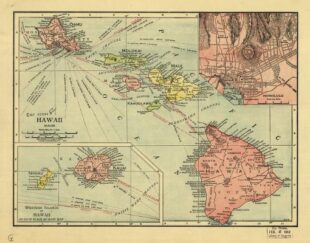
Rand Mcnally And Company. Hawaii. [S.l, 1912] Map. https://www.loc.gov/item/98687130/.
ADDITIONAL RESOURCES
Places to GO
Things To DO
View the 1897 Petition Against the Annexation of Hawaii, signed by more than 21,000 native Hawaiians, as well as the 1898 letter from Queen Liliuokalani to the U.S. House of Representatives protesting U.S. assertion of ownership of Hawai’i, at the National Archives.